


-

Illustration: clock and nave by JBG, stained glass windows by David Bordes / CMN

-

Full-grain, vegetable-tanned leather, burgundy colour, from the Italian tannery Conceria Walpier .
-

"Rice pearl" bracelet in polished and brushed stainless steel. Deployant clasp.
-

Stainless steel Milanese mesh bracelet. Safety buckle.


Detailed information
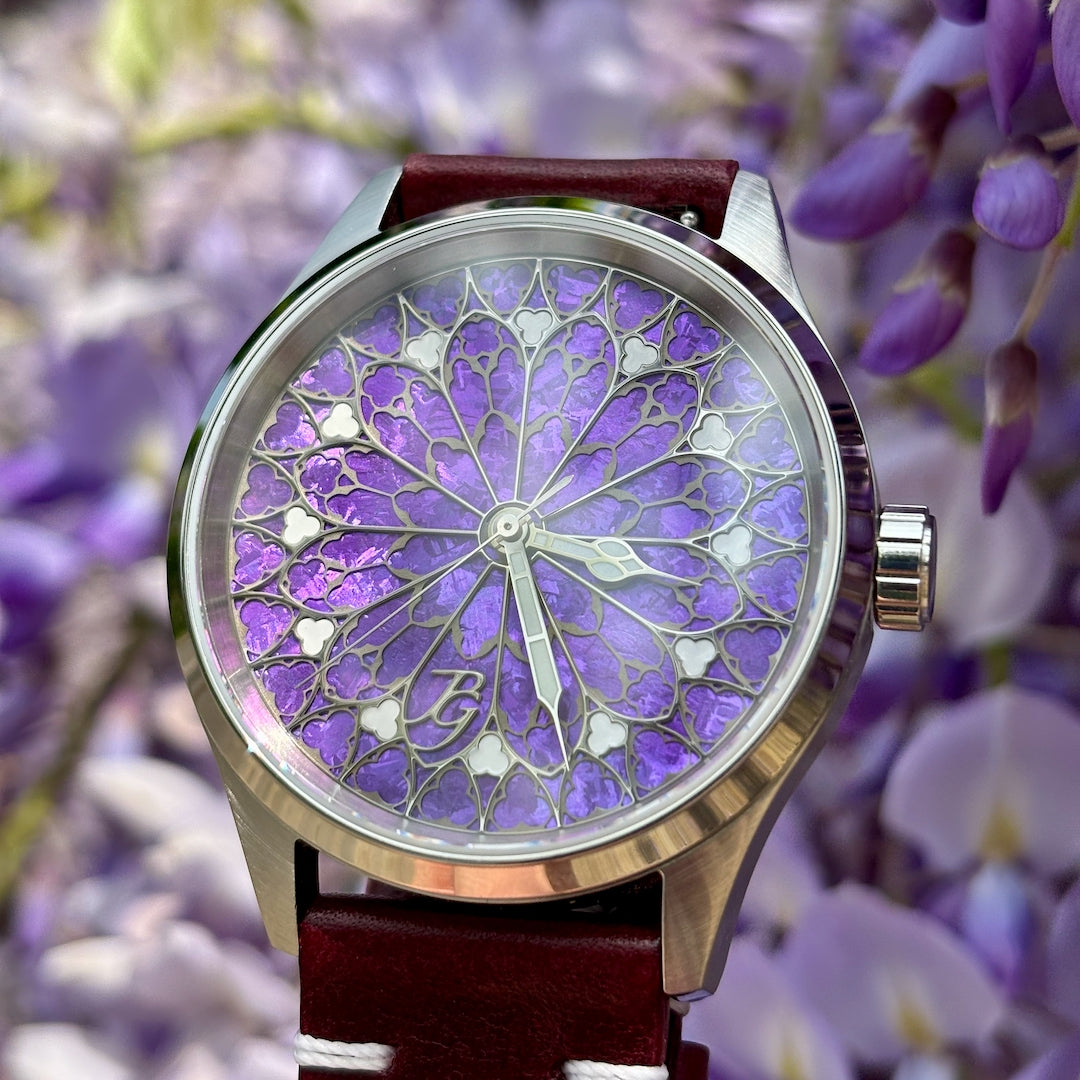
The Notre-Dame watch features an anodized titanium dial in an intense purple hue. The crystallized surface plays with light, revealing reflections in perpetual motion depending on the angle and ambient brightness, reminiscent of the interplay of light in stained glass windows.
The rose window is crafted from a delicate stainless steel mesh, alternating matte recesses and hand-polished edges to create a contrast of textures and depth. The design is inspired as closely as possible by the architecture of the south rose window of Notre-Dame de Paris. You will find more information about its history, construction, and significance below. For ease of reading, the hours are marked by hand-painted white indices.
The large case diameter (44 mm) highlights the dial's intricate design, while the lug-to-lug distance is a manageable 51 mm. For reference, the illustrations above are on an 18 cm wrist.
The watch is powered by a Swiss automatic movement ETA 2892-A2. Its compact design allows the watch to be only 11 mm thick, despite a dial three times thicker than usual standards.
Due to the crystalline texture of titanium, as well as the hand-assembled and finished components, slight variations may occur from one watch to another.

The Cathedral
Notre-Dame Cathedral, a masterpiece of Gothic art and an iconic monument of Paris, began construction in 1163 under the leadership of Bishop Maurice de Sully. The work lasted nearly two centuries, with most of it completed in the mid-14th century.
Over the years, the cathedral has gone through periods of prosperity and difficulty. Degraded during the French Revolution, it lost several statues and treasures, before regaining its splendor thanks to the restoration campaign led by the architect Viollet-le-Duc in the 19th century. This revival was notably marked by the publication of Victor Hugo's novel, Notre-Dame de Paris , in 1831, which sparked a renewed popular interest in this emblematic monument.
On April 15, 2019, a devastating fire destroyed the spire and part of the roof structure, sparking worldwide emotion. Since then, a vast reconstruction project has been underway to restore this jewel of French heritage. A living testimony to the history of France, Notre-Dame de Paris remains a place of faith, culture and universal inspiration.

The South Rose Window
The south rose window of Notre-Dame Cathedral in Paris, also known as "rose du midi", was created in 1260 under the leadership of King Saint Louis. With an exceptional diameter of 12.9 meters, it was designed by the architect Jean de Chelles, then by Pierre de Montreuil.
Featuring 84 stained glass panels, the radiant composition is organized in concentric circles, with Christ in the center, surrounded by the 4 prophets, the twelve apostles, angels, saints and scenes from the New and Old Testaments. The 24 outer 3-leaf clovers represent the divine trinity, while the 12 4-leaf clovers symbolize humanity: the union of the two, divinity and humanity, symbolizes the Incarnation (God incarnating in a man, Jesus).
Beyond religious iconography, this rose window can also be read in a more political way. In the transept; it faces a second rose window with a very symmetrical composition, based on the number 8, symbol of perfection. The message of these rose windows is therefore the following: “the Incarnation is perfection”.
At the time of the construction of Notre-Dame, this declaration was aimed directly at the Cathars, who were fiercely opposed by the papacy and the kingdom of France. Catharism rejected the principle of incarnation, considering the material world as intrinsically evil and affirming that God could not be incarnated in a physical body. By proclaiming incarnation as perfection, these rose windows reaffirm Paris' support for the fight against the Cathars, which took the form of a bloody crusade in the south of France in the 13th century.
The stained glass windows have been restored several times over the centuries. The rose window was fortunately spared by the fire of 2019 and continues today to be a symbol of the beauty and resilience of sacred art.
-

Overview of the south rose window © David Bordes / CMN
-

Details of the south rose window © David Bordes / CMN
-

Drawing of the south rose by Viollet-le-Duc (Reasoned dictionary of French architecture from the 11th to the 16th century)
-

Details of the south rose window © David Bordes / CMN
-

Interior view of the south rose window
-

Notre-Dame de Paris newly restored in 2025


