


-

Illustration: clock and nave by JBG, stained glass windows by David Bordes / CMN

-

Horween Shell Cordovan leather, navy blue color.
-

"Rice pearl" bracelet in polished and brushed stainless steel. Deployant clasp.
-

Stainless steel Milanese mesh bracelet. Safety buckle.


Detailed information
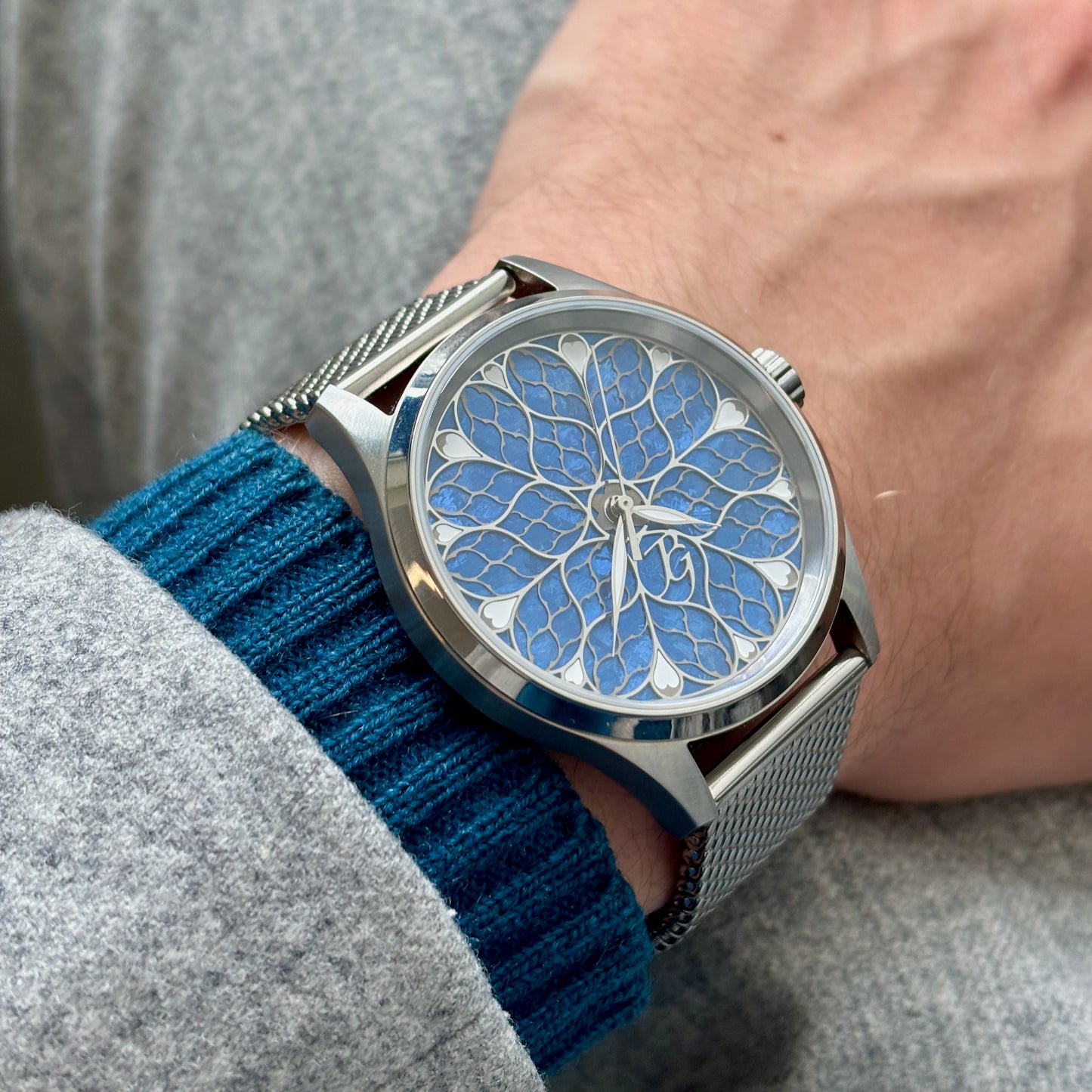
The Sainte-Chapelle watch is characterized by an anodized titanium dial in an intense blue color. The crystallized surface plays with light, revealing reflections in perpetual motion depending on the angle and ambient light. It thus evokes the interplay of light in stained glass windows.
The rose window is crafted from a delicate stainless steel mesh, alternating matte recesses and hand-polished edges to create a contrast of textures and depth. The design is inspired as closely as possible by the architecture of the West Rose Window of the Sainte-Chapelle in Paris. Further information about its history, construction, and significance can be found below. For ease of reading, the hours are marked by hand-painted white indices.
The large case diameter (44 mm) highlights the dial's intricate design, while the lug-to-lug distance is a manageable 51 mm. For reference, the illustrations above are on an 18 cm wrist.
The watch is powered by a Swiss automatic movement ETA 2892-A2. Its compact design allows the watch to be only 11 mm thick, despite a dial three times thicker than usual standards.
Due to the crystalline texture of titanium, as well as the hand-assembled and finished components, slight variations may occur from one watch to another.

The Sainte-Chapelle of Paris
The Sainte-Chapelle in Paris is a masterpiece of the Rayonnant Gothic style located on the Île de la Cité, in the heart of Paris. Built between 1242 and 1248 at the request of King Saint Louis, its main purpose was to house sacred relics, including the Holy Crown of Thorns and a piece of the True Cross, acquired by the king from the Emperor of Constantinople. These relics represented a major symbol of the spiritual and political power of the French monarchy.
The chapel is part of the Palais de la Cité, the residence of the kings of France from the 10th to the 14th century. The building is made up of two levels: a low, dark chapel for the staff of the royal palace, and a high chapel reserved for the king, his court and the exhibition of relics. It impresses with its height, its almost entirely glazed space and its celestial atmosphere.
Over the centuries, the Sainte-Chapelle suffered damage, particularly during the French Revolution, when it was stripped of many decorations and relics. However, it was restored in the 19th century under the direction of the architect Eugène Viollet-le-Duc, which allowed it to regain its splendor.

The Western Rose
The Rose Window of the Apocalypse, located in the upper chapel of the Sainte-Chapelle in Paris, is one of the most spectacular and emblematic elements of this Gothic building. Installed in the 15th century, during the reign of Charles VIII, it illustrates the Apocalypse according to Saint John, the last book of the New Testament. In a more political way, it was also a way for the king to recall his mission: to guide and protect his people until the Last Judgment.
About 9 meters in diameter, this rose window is characterized by a flamboyant style, with a design composed almost exclusively of curves, almost organic. It forms a stone lace whose finesse represents the culmination of Gothic architecture:
“It was not possible to push the lightness further in these combinations of stone networks intended to hold stained glass windows. The science of tracing, the precision of execution, the calculation of pressures and resistances, had [here] reached their ultimate limits.”
Eugene Viollet-le-Duc,
Dictionary of French architecture from the 11th to the 16th century
-

Western rose window and glass roof
-

Comparison of watch and exterior facade
-

Drawing of the western rose by Viollet-le-Duc (Reasoned dictionary of French architecture from the 11th to the 16th century)
-

Details of the Western Rose


